


Proposition NN is a holdup artist with a halo.
The measure, titled “Keep and Spend Money for Education and Other Purposes,” waxes on about teacher pay, smaller classes and doing it all without raising taxes.¹ Instead, it jacks up the TABOR limit so our democratic socialist legislature can keep the surplus the Colorado Constitution says belongs to the people who earned it.
The campaign deceptively promotes it as "Say Yes to Colorado Kids.”
The highly credible Common Sense Institute pegs the take at about $330 million the first year and $521 million the next, with refunds gone for the foreseeable future.² That’s money already collected. It is yours unless enough voters volunteer to let inept authorities keep it. They wrote the question so a “yes” vote feels like hugging a child. A “yes” vote is, in fact, a raise for an administrative workforce that has long failed at the job and shown no love for the children.
The $4.6 billion we keep hearing about is how far the spending limit rises. It is not a check to schools.³ The state only keeps extra money in years it collects more than today’s cap allows. And that leftover cash isn’t headed for classrooms. First it backfills property-tax breaks for seniors and disabled veterans. What’s left goes into something called the Children’s Account. At least half of that goes to K-12 for the first decade. The rest can go to preschool, child care and other programs they label “for children.” After 10 years, the legislature decides — meaning they can spend it on anything.⁴
Then there’s the promised 2 percent increase every year. That’s 2 percent more for K-12 as a whole enterprise, not a 2 percent raise for our state’s beleaguered teachers. It lasts 10 years, and it happens only if the leftover money is big enough. No leftover, no bump for education.⁵ The higher spending cap, meanwhile, never expires.⁶ So the promise to fund classrooms is deceptive. It’s more of a “maybe-this-year, if things work out” proposition. The permission to keep your refund is forever. It’s a permanent shakedown dressed up as a subsidy for children.
Consider the employee in the doorway
In Colorado, public school enrollment peaked at 913,223 in 2019. The latest count is 870,793. That’s more than 42,000 students gone, with enrollment dropping in five of the last six years.⁷ Last fall, 138 of 178 school districts shrank. More than 10,000 students left in a single count, the biggest drop since the pandemic.⁸ Kindergarten and first grade are shrinking faster than the rest, which means the empty desks are not a hangover. They are the next decade.
Students did not spontaneously combust. They fled for better options. Instead of upping their game in response, the K-12 establishment — ruled by the monolithic teachers’ unions — works diligently to destroy the competition. They don’t care about the children harmed by their war on competition and choice.
While the customers (students) left, management hired more managers. Since 2021, administration has grown by 13 percent. Teachers numbers have shrunk. State per-pupil funding jumped 27 percent in three years, from about $9,000 to $11,450.⁹
The product? On the 2026 CMAS tests, 44.7 percent of kids in grades three through eight met the minimal English standard. In math, 37.3 percent.¹⁰ Eleventh-grade math on the SAT? Fewer than one in three.¹¹ On the Nation’s Report Card, 36 percent of Colorado fourth graders read at a proficiency.¹² The system’s adults fail to teach most children to meet minimum standards, and they have the audacity to ask for a staggering expansion of the administrative slush fund. It’s like the underperforming employee saying, “I’ll do better, if you give me a massive raise.”
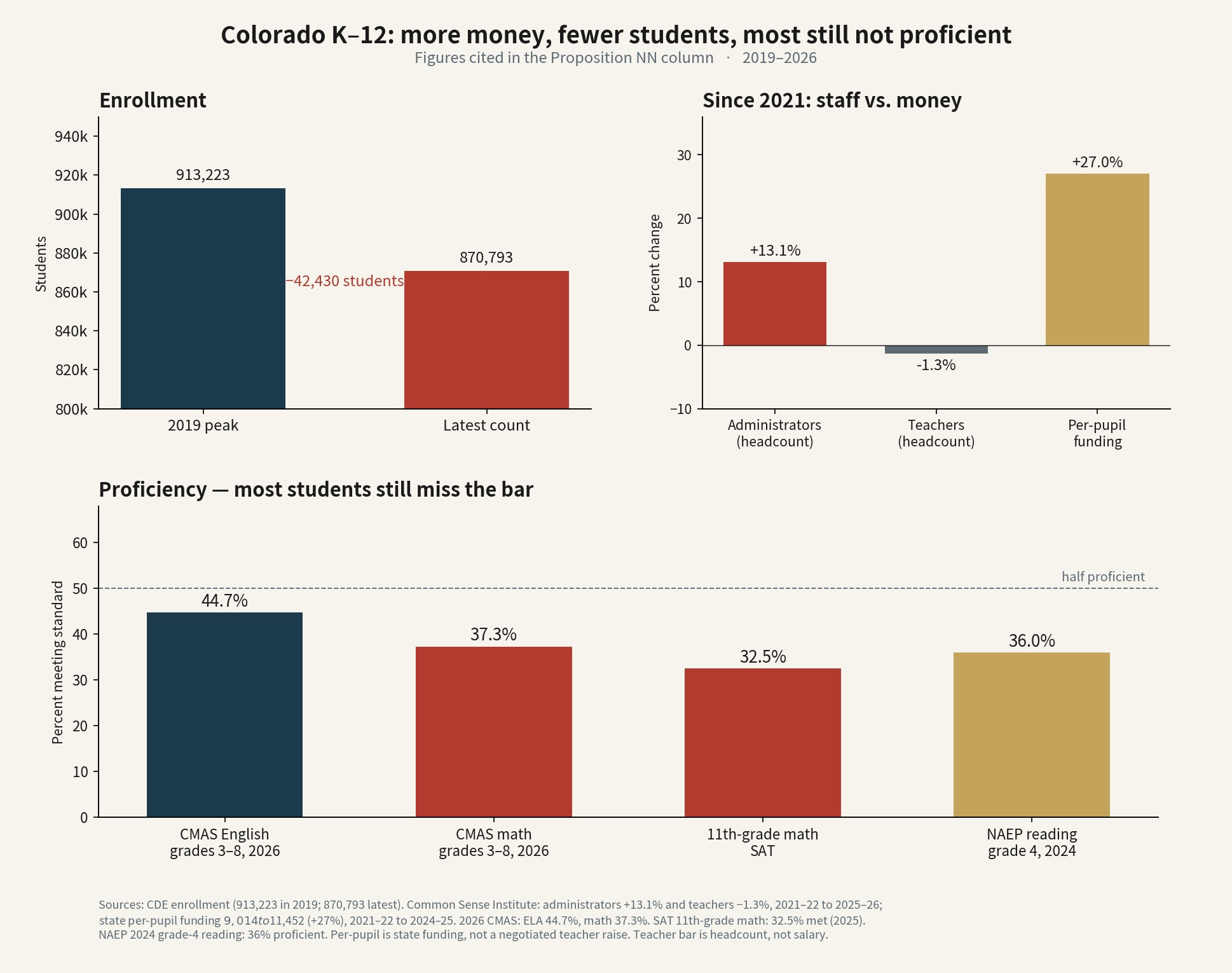
Despite the disturbing data in the graph above, the K-12 establishment wants more money from taxpayers already struggling to make ends meet and provide for their children.
Our K-12 system is a well-guarded monopoly that cashes checks, adds superfluous administrative staff to the central office, and sends children into the market who cannot read, write, add, or subtract. As explained in a previous column, other countries — especially China — are blowing us away. Imagine what that portends for our future.
They did not stop at failure, they punished escape
Education reEnvisioned BOCES, known as ERBOCES, committed the unforgivable. It helped parents get their children out of a failing system. Homeschool enrichment. Part-time programs. Online schools. A door for families who had already written off the neighborhood K-12 childcare factories. All told, ERBOCES served 13,500 students last year, more than 8,000 of them in homeschool enrichment.¹³ Millions of dollars followed the students instead of further bloating the central office. The legislature, bought and paid for by the teachers’ unions, did not respond with a “what can we learn from this to win back the students?” It was a more like a mafia-style raid on the competition.
In the final days of the 2026 session, lawmakers loaded the School Finance Act with tripwires built explicitly to destroy ERBOCES. No programs outside its home turf. No activities a regular public school doesn’t offer, negating the purpose of the program. No private-school kids on the part-time roll. Enrollment caps.¹⁴ It was a take-no-prisoners, full-fledged, broadside assault on the children who needed these programs.
With ERBOCES boxed in and the state education commissioner leaning on it, the District 49 school board — under state duress, in the form of financial threats and other punishments — voted in August to end its sponsorship of ERBOCES. All 13,500 children lost their authorizer just days before the start of the school year. The state handed the online schools and their 4,700 students to District 49 for a year. Then it denied applications for all 44 of the co-op’s enrichment programs, leaving more than 8,000 children in a lurch the politicians don’t give a damn about.¹⁵
Colorado Homeschool Enrichment, a network that served nearly 2,800 students on 48 campuses, shut its doors in September.¹⁶ Riverstone Academy, the tiny Christian school they treated like a contagion, closed — despite U.S. Supreme Court rulings that say state’s cannot financially discriminate against schools on a basis religion.¹⁷
Socialist politicians celebrated $21 million “saved” next year and $30 million the year after.¹⁸ “Saved,” that is, by commandeering money from children with unique talents and needs. “Saved,” as in confiscated for a monopoly that cannot get 40 percent of eighth graders to achieve basic math expectations.¹⁹
Colorado has no education savings account and no state voucher. To his great credit, Gov. Jared Polis, a founder of charter schools, signed on to the new federal tax-credit scholarship. That’s the whole menu.²⁰ Choice exists as a brochure. When families used a sliver of public money for programs that didn’t feel like a holding pen, the legislature’s answer was simple: Kill the programs because we can’t compete with them. The far left always chooses destruction over logic because their attempts at rationale don’t work.
The democratic socialist-dominated legislature, not parents, will control how and what children learn. Students will learn that their country was stolen. They will learn that white students are oppressors and nonwhites are helpless victims with an excuse to underperform. Children will learn that their parents are antediluvian. Most students will encounter one or more teachers who say they could be mistakes of nature in need of sex-change procedures. Hundreds of Colorado parents know this fact first hand.
Boulder Valley is closing schools.²¹ Colorado Springs District 11 slaps a $775 million bond on the same ballot.²² More money for fewer students in chairs. Charter schools, built around what parents want, have to fight for a bus. They live under the constant threat of forced closure. Prop NN will only bolster the administrative payroll (teachers come last), block the exit, and call it “equity.”
Prop NN is not, by any stretch, an effort to help children. If they cared about the students they wouldn’t have squashed the homeschool enrichment programs. If they cared about them our proficiency scores wouldn’t be a crime scene.
Before voting understand who wins. The beneficiaries of NN are the adults who’ve grown the org chart and already treated school choice as a budget leak. Now they want the TABOR limit raised forever. That way, the next surplus never reaches the homes of parents struggling to make ends meet and provide for their children.
Bloat the wage of the third assistant deputy of public relations and leave the teachers living paycheck-to-paycheck.
The promised “independent audit” is a smokescreen.²³ They will spend. They will hire bureaucrats who never see a classroom. They will issue a PDF to make it look good. They will not return the kids they drove out or the years of schooling they’ve stolen from them.
A shop owner who loses customers, fattens management, flunks inspection and then blockades the side door should not get a raise. Do not lift TABOR for people who use children as a props and school choice as a target.
If the NN proponents cared about children — more than administrative bloat — they would teach them to read, write, add, and subtract. As a matter of statistical, documented fact, they do almost none of that. “Vote no” — “hell no” if possible — on the fool’s gold they’re trying to sell you for cash.
Notes
Colorado Legislative Council, 2026 State Ballot Information Booklet, Proposition NN. The measure was referred by the legislature through Senate Bill 26-135. See also CPR News, “Proposition NN: TABOR and school funding,” Sept. 25, 2026.
Common Sense Institute, “The Economic and Fiscal Impacts of Proposition NN,” Aug. 6, 2026. The estimates are $329.9 million for fiscal 2026-27 and $521 million for 2027-28, or $850.9 million over two years. Other forecasts differ, and all are projections.
Ibid. The $4.6 billion equals current state K-12 funding, the amount by which the limit rises in the first year. The state keeps only revenue above the old limit. See also KUNC, “Colorado voters will be asked to give up billions in TABOR refunds,” May 13, 2026.
KUNC, May 13, 2026; CPR News, Sept. 25, 2026. The backfill covers the homestead exemption for seniors, disabled veterans and Gold Star spouses.
KUNC, May 13, 2026. The first-year increase is about $107 million and is capped by the amount of money actually retained.
CPR News, Sept. 25, 2026, quoting the Blue Book: the new limit “continues indefinitely.”
Colorado Department of Education, fall 2025 enrollment release; Colorado Springs Gazette, Aug. 29, 2026. Enrollment ticked up in fall 2021 before falling again.
Chalkbeat Colorado, “Public school enrollment declines by 10,000,” Jan. 13, 2026. The fall 2025 drop was 10,272 students. Kindergarten fell 2 percent and first grade 2.5 percent, versus 1.2 percent overall (CDE).
Common Sense Institute, “Administrative Growth, Student Decline, and Academic Performance in Colorado’s Public Schools.” Administrators rose 13.1 percent from 2021-22 to 2025-26 while teachers fell 1.3 percent. Per-pupil figures are state funding, 2021-22 to 2024-25, not adjusted for inflation.
CDE, 2026 state-level CMAS, PSAT and SAT results; Chalkbeat Colorado, Aug. 19, 2026. Figures are the share that met or exceeded expectations.
CDE, 2026 results: 31.6 percent of 11th graders met or exceeded the SAT math benchmark.
National Assessment of Educational Progress, 2024 reading results. Thirty-six percent of Colorado fourth graders scored at or above Proficient.
Chalkbeat Colorado, Aug. 14, 2026; Colorado Springs Gazette, “Online schools safe, homeschool programs uncertain following ERBOCES dissolution,” Aug. 24, 2026, citing the Colorado Department of Education for the 13,500 total.
Chalkbeat Colorado, May 12, 2026; Senate Bill 26-023, the 2026 School Finance Act.
Chalkbeat Colorado, Aug. 18, 2026. The commissioner also cited governance problems, including a board state officials said was improperly constituted. On the online schools, see CDE, State Board release, Aug. 21, 2026: 4,707 students, transferred to District 49 for 2026-27 only. On the enrichment programs, see the Gazette, Aug. 24, 2026: the state denied the 44 applications because of the dissolution but let programs reapply by Sept. 4 if they found a new authorizer.
Chalkbeat Colorado, “Huge homeschool enrichment program closes,” Sept. 4, 2026.
Chalkbeat Colorado, June 2, 2026.
Chalkbeat Colorado, May 19, 2026, citing state estimates.
CDE, 2026 results: 37.8 percent of eighth graders met or exceeded expectations in CMAS math.
CPR News, Jan. 29, 2026.
CPR News, Sept. 23, 2026.l
The Gazette, Aug. 5, 2026.
The ballot title requires “an annual publicly released, independent audit.” CPR News, Sept. 25, 2026.