


Colorado Attorney General Phil Weiser is a friend, an early guest on my podcast, and—by favor of enormous odds—will be the next governor. Among Democrats, he has long stood out as pro-business. He understands markets, innovation, and the damage caused when powerful players crush competition. That is why his position on school choice smacks of politically motivated hypocrisy.
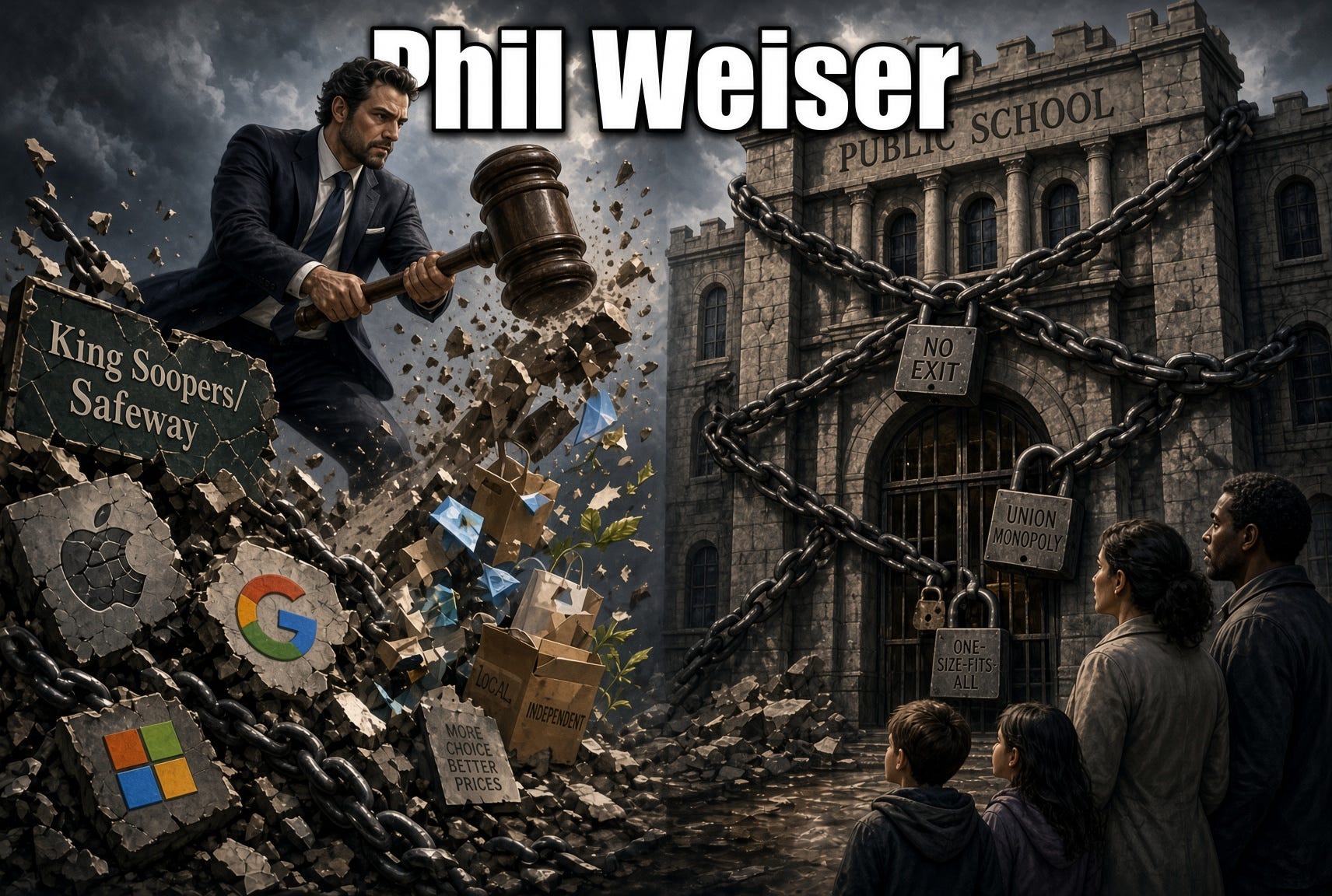
Weiser, the Democratic nominee for governor, has made his intent crystal clear. If elected, he will opt Colorado out of the new federal Education Freedom Tax Credit. That program allows taxpayers a credit for donations that fund scholarships—money parents can use for private schools, tutoring, or other educational options. In plain terms, it injects competition into a system that desperately needs it.
Weiser has opposed it repeatedly and without ambiguity. On X in December 2025 he wrote: “While I welcome any support for education and investing in our kids’ future, I will never support vouchers.” He has repeatedly told the educational establishment that he would opt the Colorado out of this new hope for educational choice, a concept that began with the U.S. Supreme Court’s ruling in Brown v. Board of education. That ruling that allowed Black students to attend better-funded whites-only schools. The ruling gave minoirty families the right to school choice, and the National Education Association, the teachers’ union’s umbrella, refused to support it.
Weiser, who opposes the Supreme Court’s liberation philosophy stated in Brown, has spent decades fighting monopolies. My friend favors choice in all aspects of American life, except when it involves education.
Weiser served as senior counsel to the head of the Justice Department’s Antitrust Division under President Clinton, forcing competition in telecommunications. Under President Obama was Deputy Assistant Attorney General in the same division. He taught competition as dean of the University of Colorado Law School, founded the Silicon Flatirons Center (which strongly advocates competition), and built a national reputation as an opponent to allowing concentrated power to harm consumers by denying the choice established by competition.
As Colorado Attorney General he led a multi-state suit that blocked the $24.6 billion Kroger-Albertsons merger—the deal that would have combined King Soopers and Safeway. He argued it would eliminate head-to-head competition, raise prices, and harm workers and consumers. He challenged an illegal no-poach agreement between the companies during the 2022 King Soopers strike.
Weiser has co-led major cases against Google for maintaining illegal monopolies in search and digital advertising. He joined multi-state efforts against Facebook. He has opposed other consolidations that would reduce choices for Coloradans—in healthcare, broadcasting, technology, and more. If it reduces choice, Weiser opposes it.
His principle has been always been the same: competition and choice protect consumers. Choice disciplines the powerful. Monopolies lead to higher prices, lower quality, minimal efficiency, less innovation, and poor outcomes.
Suddenly, these indisputable principles of economic science have changed. Because Weiser wants the financial support and endorsements of the teachers’ unions, he won’t tolerate school choice and will spare not effort to protect the K-12 stranglehold.
Nothing spells monopoly like the traditional one-size-fits-all public school system run by the openly socialist, anti-capitalist (as stated in writing) monolith of teachers’ unions. The Colorado Education Association and its national counterparts treat competition as an existential threat. They fight charters, vouchers, education savings accounts, and any policy that lets parents walk away from failing schools. They prefer captive customers—children assigned by ZIP code—and a political machine that extracts dues while settling for stagnant results in the form of abysmal test scores and graduation rates.
Weiser has spent his career saying Safeway and King Soopers cannot merge because that would harm shoppers. He has scrutinized consolidations health and tech platforms to ensure competition for consumers. Yet when it comes to the education of children, the same man insists there should be no meaningful exit, no portable funding, and no benefit of competition. To be consistent, he would oppose the Supreme Court liberating Linda Brown from her underperforming all-Black school in Topeka.
That is ideological cognitive dissonance of the highest order. It is also a direct attack on the middle class and the poor. It allows school choice for the wealthy, who can afford it, but denies it to those who could use the assistance of private donors.
For my wife and me, it’s a gut punch from an unlikely source. Choice, and our ability to exercise it, saved the life of one of our six children. He was failing in a traditional high school, suffering depression, and heading in a dangerous direction. His love was aviation and flight simulator that occupied most of his free time. We put him in Colorado Wings Aerospace Academy (now Wings Aerospace Exploration). He graduated at the top of his class, went on to graduate from college, ans supports himself, his wife, and our first grandchild. He bought a home at age 23 in Colorado Springs, where the average age of firt-home buyers is 40.
If competition is protects adult retail consumers, it protects struggling children. If Weiser considers monopolization intolerable among Google and Facebook attempt, he should feel equally offended by monopolized schools.
The Education Freedom Tax does not “defund” public education any more than a new Whole Foods defunds King Soopers. It simply gives consumer the leverage of choice, and each company must constantly improve. In the case of the freedom tax credit, the new competition is funded with new donations that don’t draw on school district budgets.
I respect Weiser’s intellect and his long record of taking on concentrated economic power. That is precisely why his refusal to apply the same logic to education amounts to placing political ambitions above the welfare of children and families. When the monopoly in question is the one controlled by “Democratic” socialist institutions and union power, the antitrust champion suddenly views central planning—authoritarian control of consumers—as a virtue. It’s BS, my friend.
Coloradans should notice the contradiction. Competition is not a partisan principle. It either improves outcomes or it does not. If Weiser is willing to protect competition in retail and industry, he should naturally champion parents choosing schools, with new money, that work better for their children. Anything less is special pleading for the most entrenched monopoly in American life.
AI Note: This article and others are mine, written by me over the course of hours. Like most writers, I use AI for editing and research to ensure the best outcome for readers.